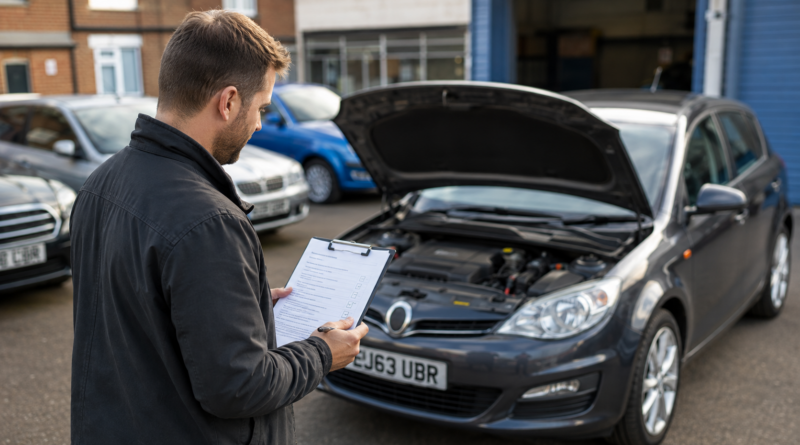
Free Used Car Buying Checklist 2026 + UK Forms
Finding a genuinely good used car by yourself is harder than it appears.
The problem is not only a lack of mechanical knowledge. The bigger problem often begins when you find a car you already want to buy. You like the colour, specification, interior, shape or price, and the vehicle starts to feel right before you have properly checked it.
From that point, it becomes easy to look for evidence that supports the purchase while explaining away evidence that does not. A warning light becomes “probably just a sensor”. A gearbox hesitation becomes “normal for the model”. A seller refusing an inspection becomes “they must be busy”. A poor paint match becomes “just the lighting”.
This is a recognised decision-making risk. Positive feelings can influence how people judge benefits and risks, while confirmation bias can lead people to favour evidence that supports a conclusion they already want to reach. See research on the affect heuristic and confirmation bias.
“I like this car” and “this car is worth buying” must be treated as two separate decisions.
The free CarExamer documents below are designed to make that separation easier. They help you record evidence, treat an uncompleted check as uncertainty and prevent one serious warning sign from being hidden by several acceptable results.
They are practical first-stage buying tools. They cannot replace an independent inspection where important evidence is missing, the vehicle shows mechanical or structural warning signs, or you cannot assess it properly yourself.
Download the free CarExamer buyer documents
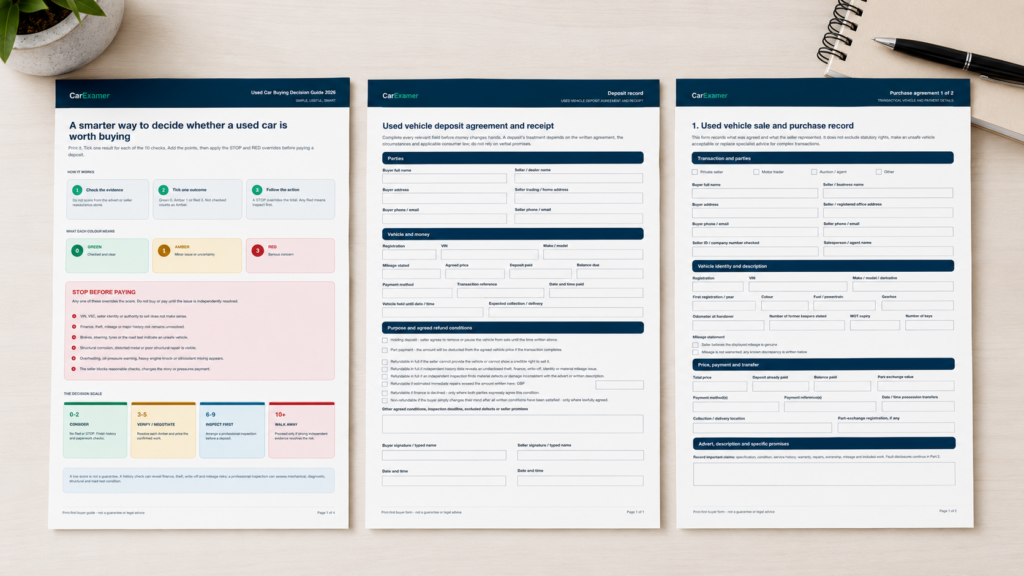
Used Car Buying Decision Guide 2026
Download the free Used Car Buying Decision Guide 2026
This four-page printable guide uses ten checks covering the seller, vehicle identity, history, accident-repair signs, tyres, brakes, suspension, underbody, cold-start behaviour, fluids, diagnostics and road-test condition.
Each check is marked Green, Amber or Red. An uncompleted check counts as Amber, while specified identity, finance, safety, structural and serious engine concerns override the numerical score.
Used Vehicle Deposit Agreement and Receipt
Download the free Used Vehicle Deposit Agreement and Receipt
The printable deposit record covers the buyer, seller, vehicle, deposit amount, balance, reservation period, payment reference and the written circumstances in which the deposit is refundable or retained.
Used Vehicle Purchase Agreement
Download the free Used Vehicle Purchase Agreement
The two-page purchase agreement records the parties, vehicle identity, mileage statement, payment, seller claims, known faults, declarations, documents handed over and signatures.
These forms are general buyer records, not legal advice. They do not prove ownership, remove statutory rights, make an unsafe vehicle acceptable or guarantee that the car has no hidden or future faults.
Used Car Buying Guide: What to Check Before You Commit
The checks below follow the order a careful buyer should use: investigate the vehicle before travelling, confirm the seller and paperwork, inspect the car from cold, examine its physical condition, complete a meaningful road test and record every material promise before paying.
For each area, consider four questions:
- What could be wrong?
- What evidence do you actually have?
- Can you assess the risk yourself?
- Does the result support buying, negotiating, arranging further checks or walking away?
1. Check the seller, V5C, VIN and vehicle history
What can go wrong?
A car can appear clean and drive well while still being a bad purchase because its identity, history or seller cannot be verified.
Potential problems include:
- The seller has no credible authority to sell the vehicle.
- A trader is presenting the sale as a private transaction.
- The registration or VIN does not match the V5C.
- The car is subject to outstanding finance.
- The vehicle has been reported stolen.
- It has an undisclosed insurance write-off marker.
- The recorded mileage is inconsistent.
- The advert describes a different model, derivative or specification.
- The seller’s name, address and bank-account details do not form a credible explanation.
A V5C shows who is responsible for registering and taxing the vehicle. It is not proof that the named keeper legally owns it. DVLA has specifically warned buyers not to treat the V5C as proof of ownership and recommends asking for additional evidence where necessary. See DVLA guidance.
What can a normal buyer check?
Before travelling, ask the seller for:
- The registration number
- Make and model
- Current mileage
- MOT information
- The seller’s full name
- Whether the V5C is present
- Whether the seller is a private individual, dealer, auction or agent
- Confirmation that an independent inspection is permitted
Compare the details with DVLA data. Check the MOT history and recall status. At the vehicle, inspect the original V5C and compare the VIN and engine number with the car. GOV.UK recommends carrying out these checks before and during the viewing.
For a private sale, ask why the seller’s name or address differs from the V5C if it does. There may be a legitimate explanation, such as selling for a relative, company ownership or a recent keeper change, but the explanation should be supported by evidence.
Do not ignore a payment request to an unrelated bank account. The seller, vehicle documents, invoice and receiving account should form one credible transaction.
What usually needs a separate data check?
A physical inspection cannot establish whether finance remains outstanding or whether a theft or insurance marker exists in external databases.
Use a vehicle history check to investigate:
- Outstanding finance
- Theft records
- Insurance write-off information
- Mileage discrepancies
- Registration data
- Vehicle identity information
CarExamer’s current history service offers free DVLA and MOT information as an initial step, followed by paid options for finance, theft, write-off, mileage and related vehicle data.
A history report does not assess the present mechanical condition of the vehicle. It cannot tell you whether the gearbox hesitates, the coolant is contaminated, the suspension knocks or a body repair has been completed badly.
Why does it matter?
An identity or ownership problem can be more serious than a mechanical fault.
A repairable mechanical defect may justify negotiation. Unresolved finance, theft risk, a false VIN or a seller with no credible authority to sell can place the entire transaction in doubt.
What should you do next?
Proceed only when the seller, V5C, VIN, registration, history data and payment details form one consistent story.
A small discrepancy with a clear written explanation requires verification.
An unresolved VIN mismatch, theft concern, outstanding finance issue, false identity or absence of credible authority to sell is not a negotiation point. Stop the transaction.
Check the latest official guidance before making a final decision, as rules and costs can change.
2. Compare the advert with the actual car and the seller’s story
What can go wrong?
Many expensive buying mistakes begin with a description that changes gradually.
Examples include:
- “Full service history” becoming several stamps with no invoices
- “Never damaged” becoming “only a minor repair”
- “No warning lights” becoming “that one appeared yesterday”
- “Perfect gearbox” becoming “they all hesitate like that”
- “Cold start available” becoming a vehicle that is already warm
- “Any inspection welcome” becoming a refusal when you try to arrange one
- An advertised warranty disappearing from the paperwork
- A claimed recent repair having no invoice or evidence
The seller may not be deliberately dishonest in every case. They may simply not understand the vehicle. The result for the buyer is the same: an unsupported claim should not be treated as evidence.
What can a normal buyer check?
Save the entire advert before contacting the seller. Keep:
- The price
- Mileage
- Vehicle description
- Photographs
- Service-history claims
- Statements about faults or damage
- Warranty information
- Promised repairs
- Number of keys
- Included accessories
- Seller identity
- Messages and emails
At the viewing, compare the car with those claims one by one.
Ask direct questions:
- How long have you owned the vehicle?
- Why are you selling it?
- Has it ever overheated?
- Does it use oil or coolant?
- Have any warning lights appeared?
- Has the gearbox, clutch or emissions system required work?
- Has it suffered accident damage?
- What has been repaired recently?
- Is anything intermittent?
- Is there outstanding finance?
- Can an independent inspector examine and road-test it?
Avoid asking only, “Is everything all right with it?” That question invites a general reassurance rather than useful information.
What seller behaviour should concern you?
Be cautious when the seller:
- Refuses to provide the registration number
- Will not show the V5C
- Changes the viewing location repeatedly
- Insists on meeting away from their address without explanation
- Appears to be selling several unrelated vehicles privately
- Will not permit a cold start
- Has freshly washed the engine bay immediately before the viewing
- Refuses diagnostic access
- Refuses reasonable underbody access
- Will not permit a meaningful road test
- Pressures you to transfer a deposit immediately
- Gives different answers when the same question is asked twice
Seller cooperation does not prove that a vehicle is good. Seller obstruction does remove evidence that you need to make a responsible decision.
What usually needs a professional inspection?
A professional inspection is appropriate where the description sounds credible but the buyer cannot independently confirm it.
Examples include:
- A claimed timing-belt replacement with weak paperwork
- A claimed gearbox service without an itemised invoice
- A warning light that the seller says has been repaired
- A recently cleaned engine bay
- A vehicle shown only warm
- A repaired accident-damaged area
- A persistent noise described as “normal”
- An intermittent fault
- A seller who permits inspection but cannot explain the symptoms
Why does it matter?
What a seller says about a vehicle has little value after the sale – unless you can prove seller’s claims and enforce your rights.
If you mention clutch operation is not correct and seller says “the clutch is fine” but later becomes a clutch and flywheel replacement, the repair bill belongs to the buyer unless there is a valid remedy against the seller. The same applies to any other issue buyer identified is not correct, servicing, accident history, mileage and promises to complete work.
What should you do next?
Record every material promise in writing.
If the seller says a fault will be repaired, specify:
- What will be repaired
- Who will complete the work
- The required standard
- The completion deadline
- Whether an invoice will be supplied
- What happens if the repair is not completed
Do not let verbal reassurance replace evidence.
3. Inspect for accident damage and poor body repairs
What can go wrong?
A vehicle may have been repaired after an accident without the work appearing in a history report.
A replacement panel is not automatically a serious problem. The risk depends on:
- Why it was replaced
- What was damaged behind it
- Whether structural areas were affected
- Whether the repair was completed correctly
- Whether corrosion protection was restored
- Whether the seller described the history honestly
Poor accident repairs can affect panel alignment, water sealing, wheel geometry, tyre wear, structural strength, resale value and future insurance decisions.
What can a normal buyer spot?
View the car in daylight and, where possible, when the body is dry.
Walk around it once from several metres away, then inspect each section closely.
Look for:
- Uneven gaps around doors, bonnet, wings or boot
- A door, bonnet or tailgate sitting too high or too low
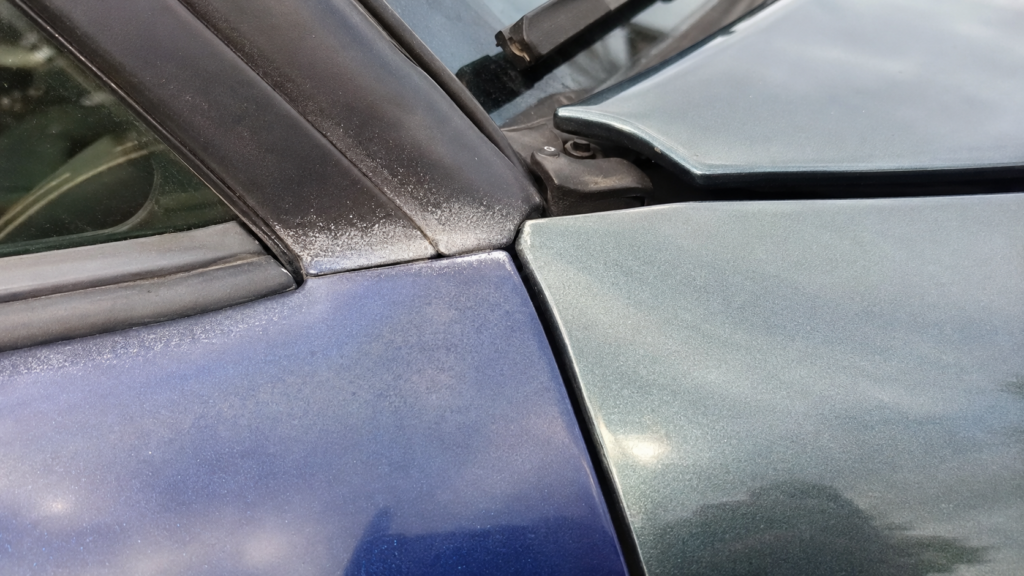
- Different paint shade between adjacent panels
- Different paint texture or gloss
- Paint overspray on rubber seals, lamps or trim
- Hard masking lines inside door apertures
- Paint on bolts that would normally retain their factory finish
- Sanding marks
- Ripples visible in panel reflections
- Cracked or irregular seam sealer
- Non-factory welding
- Uneven boot floor
- Fresh paint or coating inside the boot
- Moisture beneath carpets or in the spare-wheel area
- Headlamps or rear lamps with noticeably different manufacturing dates
- A wheel sitting differently in its arch
Open every door, the bonnet and the boot. They should latch without excessive force, lifting or dropping.
Different glass or lamp dates do not prove accident damage. They are clues that require an explanation.
What usually needs a professional inspection?
A normal buyer can identify suspicious signs but usually cannot determine the full extent of a repair.
Professional assessment may include:
- Paint-thickness readings
- Closer examination of welds and seams
- Structural-area inspection
- Comparison of corresponding areas on both sides
- Examination beneath the vehicle
- Checks around suspension and subframe mountings
- Assessment of repaired crumple-zone areas
- Evaluation of whether tyre wear may relate to alignment or impact damage
CarExamer’s current Premium package includes raised access, accident-damage assessment and broader bodywork, paintwork and structural coverage. Standard includes raised access but does not offer the same accident-damage depth as Premium. See the Premium inspection scope.
Why does it matter?
A cosmetic scuff may require only local paintwork.
A poor multi-panel repair can cost considerably more. Structural repair, corrosion around mounting points or incorrect welding may make the vehicle unsuitable regardless of the discount.
A visibly repaired panel is not necessarily a reason to walk away. A badly repaired or dishonestly described structure may be.
What should you do next?
Negotiate where the issue is cosmetic, fully understood and properly priced.
Arrange an inspection where several repair signs appear together, the vehicle is high-value, or the extent of the damage cannot be established.
Walk away where there is distorted structural metal, crude welding, serious corrosion, identity concerns or evidence of a major undisclosed repair.
4. Check tyres, brakes, steering, suspension and the underbody

What can go wrong?
A vehicle may feel acceptable on a short drive while carrying several approaching repair bills.
Tyre wear, brake corrosion and suspension symptoms can also reveal deeper problems such as:
- Poor wheel alignment
- Worn bushes or joints
- Bent wheels
- Previous impact damage
- Damaged subframes
- Seized brake components
- Weak dampers
- Broken springs
- Structural corrosion
What can a normal buyer spot?
Inspect all four tyres, including the inner and outer edges where visible.
Look for:
- Low tread
- Cracking
- Cuts
- Sidewall bulges
- Exposed cords
- Uneven shoulder wear
- Feathered tread
- Different sizes across the same axle
- Different specifications
- One new tyre beside several heavily worn tyres
- Very old date codes
- Severe wheel damage
Uneven inner-edge wear is particularly important. Replacing the tyre does not correct the cause.
Look through the wheels at the brake discs. Light surface rust after rain may clear during use. More concerning signs include:
- Heavy pitting
- Deep scoring
- A pronounced outer lip
- Blue heat marks
- Major differences between sides
- Grinding when moving
- Pulling or vibration under braking
Listen for suspension knocks, clunks or creaks. Observe whether the car sits evenly and whether it continues bouncing after a bump.
Check the visible sills and jacking points for:
- Crushing
- Flaking corrosion
- Perforation
- Filler
- Poor welding
- Recently applied coating
Look beneath the front and rear for fresh oil, coolant, fuel or hydraulic-fluid drips.
What usually needs a professional inspection?
Many important areas cannot be judged properly from the ground.
Raised access may be needed to inspect:
- Inner brake surfaces
- Suspension joints and bushes
- Springs and spring seats
- Dampers
- Steering components
- Brake pipes and hoses
- Subframes and mountings
- Exhaust condition
- Structural corrosion
- Fluid leaks above undertrays
- Previous underbody repairs
CarExamer Basic does not include raising the vehicle. Standard and Premium currently include raised access, subject to safe ground, sufficient space and practical access at the inspection location. If the underside cannot be examined, that limitation should be recorded. See the Basic inspection scope.
Why does it matter?
A pair of worn tyres may be a measurable expense.
Four tyres, heavily corroded brakes, worn suspension and poor alignment are a different buying proposition. The combined cost can reach high hundreds or several thousand pounds depending on the vehicle.
Steering, tyre and brake defects can also make the vehicle unsafe to test or collect.
What should you do next?
Negotiate for ordinary consumable wear when the work is understood.
Arrange further checks when uneven tyre wear, steering vibration, suspension noise and alignment problems appear together.
Walk away or stop the test if the tyres, brakes or steering make the vehicle unsafe.
Repair costs vary by model, region, parts availability and labour rate. Do not treat any estimate as guaranteed.
5. Insist on a genuine cold start
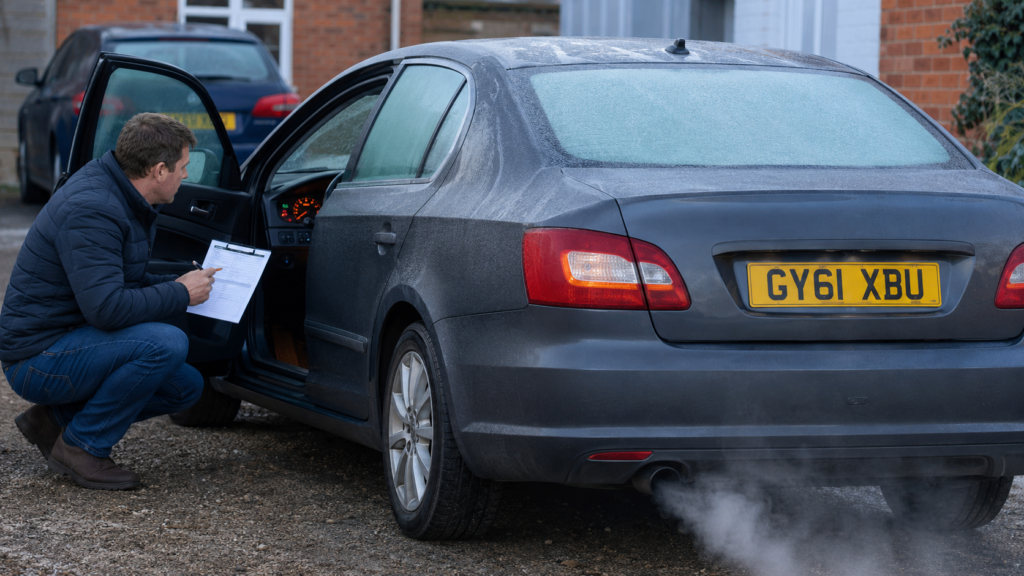
What can go wrong?
A warm engine can temporarily conceal symptoms that appear after the vehicle has been standing.
These may include:
- Slow starting
- Weak battery performance
- Glow-plug faults
- Timing-chain noise
- Valvetrain noise
- Rough idle
- Misfire
- Excessive smoke
- Low oil-pressure delay
- Coolant leakage
- Symptoms that improve as components warm
A car shown only warm has not passed a cold-start check. The check simply has not been completed.
What can a normal buyer check?
Ask the seller in advance not to start the engine before the appointment.
Before starting:
- Check whether the temperature gauge appears cold.
- Look underneath for fresh drips.
- Check the oil level where safely accessible.
- Check the coolant only when the engine is cold.
- Inspect visible hoses, belts and wiring.
- Look for dried coolant residue.
- Note wet oil around covers, hoses or joints.
- Check whether the engine bay has been cleaned more recently than the rest of the vehicle.
Never remove the cap from a hot pressurised cooling system.
Turn the ignition on before starting. Observe the warning-light self-test. Relevant lights should normally illuminate and then extinguish in accordance with the vehicle’s design.
During the start, note:
- Cranking speed
- Number of attempts
- Metallic rattles
- Heavy knocking
- Belt squeal
- Uneven idle
- Shaking
- Stalling
- Strong fuel smell
Watch the exhaust.
A small amount of water vapour on a cold or damp day can be normal. Persistent smoke requires investigation:
- Blue or blue-grey smoke may indicate oil entering the combustion process.
- Dense white smoke, particularly with coolant loss or a sweet smell, may indicate a cooling-system or internal-engine problem.
- Persistent black smoke may relate to over-fuelling, restricted airflow, injector, turbocharger or emissions-system faults.
Smoke colour is a clue, not a complete diagnosis.
What fluid warning signs matter?
Check for:
- Oil below the minimum level
- Coolant below the expected level
- Oily contamination in the coolant
- Heavy creamy contamination in the oil
- Mixed or rusty coolant
- Fresh leakage
- Repeated coolant top-ups
- Overheating history
- Strong burning-oil or coolant smells
A small amount of pale residue beneath an oil cap can result from condensation and short journeys. Heavy contamination combined with coolant loss, overheating or persistent white smoke is much more serious.
What usually needs a professional inspection?
Further investigation may require:
- Diagnostic scanning
- Cooling-system pressure testing
- Chemical testing for combustion gases
- Battery and charging-system assessment
- Inspection for leaks once the engine is hot
- Model-specific evaluation of noises
- Workshop compression or leak-down testing
CarExamer’s inspection guidance states that if a vehicle has been run before the inspection, potential cold-start problems may not be identified. The normal inspection does not include an engine compression test because that would require dismantling. Cooling-system pressure or chemical testing may be recommended where contamination is found, but it is not part of the ordinary external inspection. See CarExamer vehicle guidance.
Why does it matter?
An overdue service or small oil seep may be manageable.
Persistent smoke, overheating, oil-pressure warnings, heavy knocking or oil-and-coolant contamination can indicate a major repair risk. Depending on the vehicle and cause, the exposure may range from hundreds of pounds to several thousand.
What should you do next?
Negotiate only after the cause and repair requirement are understood.
Arrange further diagnosis for smoke, repeated coolant loss, misfire, abnormal noise or temperature instability.
Walk away where the engine overheats, knocks heavily, shows an oil-pressure warning or appears to be mixing oil and coolant, unless strong specialist evidence resolves the concern.
6. Check dashboard warnings, electrics and diagnostic evidence
What can go wrong?
Modern cars can contain electronic faults that are not obvious during a brief viewing.
A seller may have:
- Cleared fault codes
- Disconnected the battery
- Dismissed an intermittent warning
- Replaced a component without diagnosing the cause
- Hidden a fault that appears only after several journeys
- Accepted a non-working safety or convenience system as normal
What can a normal buyer check?
Before starting, observe the warning-light self-test.
After starting, look for:
- Engine-management warnings
- ABS warnings
- Airbag warnings
- Transmission warnings
- Battery or charging warnings
- Oil-pressure warnings
- Power-steering warnings
- Suspension-system warnings
- Hybrid or EV system messages
- AdBlue or emissions warnings
Photograph every message before the seller dismisses or clears it.
Test the main equipment:
- Windows
- Mirrors
- Central locking
- Exterior lights
- Wipers and washers
- Heating
- Demisting
- Air conditioning
- Seat adjustment
- Heated seats
- Cameras
- Parking sensors
- Infotainment
- Bluetooth
- Steering-wheel controls
- Charging ports and cables where applicable
Slow windows and several unrelated electrical faults may indicate a weak battery, charging problem, wiring fault, water ingress or control-module issue.
What can a diagnostic scan reveal?
A plug-in scan may identify current, stored or pending fault codes where the vehicle and scanner support access.
It can help an inspector understand:
- Which systems have reported faults
- Whether warnings have stored corresponding codes
- Whether several faults may share a power-supply issue
- Whether the seller’s explanation matches the electronic evidence
- Whether further specialist diagnosis is needed
A fault code is not automatically the name of the component that must be replaced. It identifies where a system detected an abnormal condition.
What can a diagnostic scan miss?
CarExamer’s current terms explain that:
- Previously cleared codes may not be visible.
- A generic scanner may not access every manufacturer-specific subsystem.
- A very new model may not yet be fully supported.
- A fault with the diagnostic socket or electrical system may prevent communication.
- A fault appearing after the inspection cannot have been reported during it.
See the CarExamer customer terms.
Basic, Standard and Premium currently include plug-in diagnostic checks, but a scan remains one part of the assessment rather than a guarantee that every electronic fault has been found.
Why does it matter?
A failed parking sensor may justify a modest price adjustment.
An engine, transmission, braking, steering, airbag or hybrid-system warning may indicate a much more expensive or safety-related problem. Seller reassurance is not a diagnosis.
What should you do next?
Negotiate a minor convenience fault only after confirming that it is isolated.
Arrange diagnosis where a warning light is present, codes have apparently been cleared or several electrical problems occur together.
Walk away where a critical warning is combined with poor running, overheating, unsafe braking or seller obstruction.
7. Complete a proper road test
What can go wrong?
A vehicle can idle smoothly and still have major faults that appear only when moving, under load or at normal operating temperature.
A road test may expose:
- Clutch slip
- Dual-mass flywheel vibration
- Gearbox hesitation
- Harsh automatic engagement
- Transmission shudder
- Wheel-bearing noise
- Steering vibration
- Brake pull
- Suspension knocks
- Driveline vibration
- Limp mode
- Overheating
- Smoke under acceleration
Drive only with the seller’s permission and suitable insurance. Do not assume that the seller’s policy or your own policy covers the test drive.
What should the route include?
Where safe and legal, use a route that allows:
- Low-speed manoeuvring
- Normal urban driving
- Uneven road surfaces
- Braking
- Steady cruising
- Safe acceleration
- Several gear changes
- Time for the engine and gearbox to warm
Turn the radio off for part of the drive. Test with the windows closed and slightly open because some noises are easier to hear in one condition.
Manual gearbox and clutch checks
Look for:
- Difficulty selecting gears
- Grinding during changes
- Gear lever movement under load
- A clutch biting at the extreme top of its travel
- Judder when moving away
- Clutch-pedal noise
- Engine revs increasing without matching acceleration
- Burning smell
- The car jumping out of gear
A high biting point alone is not a complete diagnosis. High bite combined with slip, judder or noise is more concerning.
Automatic and dual-clutch gearbox checks
From stationary, select Drive and Reverse.
Look for:
- A long delay before engagement
- A heavy thump
- Revs flaring between changes
- Low-speed shudder
- Repeated hunting between gears
- Hesitation when pulling into traffic
- Harsh downshifts
- Warning messages
- Symptoms worsening as the car warms
Do not accept “it only needs an oil change” unless the cause has been properly established. The symptom could relate to fluid condition, software, clutch packs, a valve body, mechatronics or internal wear.
Steering, braking and suspension checks
Observe whether the car:
- Tracks straight
- Requires constant correction
- Pulls under braking
- Has an off-centre steering wheel
- Vibrates at a particular speed
- Produces pedal pulsation
- Knocks over rough surfaces
- Bounces repeatedly after bumps
- Makes a humming noise that changes with speed
- Clicks or groans on full-lock manoeuvres
Steering vibration can result from a wheel or tyre, but it may also relate to suspension, braking, drivetrain or previous impact damage.
Recheck the vehicle after the drive
Leave the engine running briefly and inspect:
- Dashboard messages
- Temperature
- Cooling-fan operation
- Fluid leakage
- Burning smells
- Coolant smells
- Smoke
- New noises
- Evidence of pressure or leakage around the cooling system
A fault that is absent at the beginning may appear only once the engine, transmission and brakes are hot.
What usually needs a professional inspection?
A professional road test combines the symptom with:
- Diagnostic information
- Tyre condition
- Brake condition
- Suspension and steering checks
- Fluid condition
- Service history
- Raised-underbody findings where included
- Model-specific fault knowledge
The road test is conditional. CarExamer inspectors will not road-test a vehicle that is unsafe or not road legal, and package descriptions state that a road test is completed only when the vehicle is safe, legal and available to drive. See the CarExamer customer terms.
Why does it matter?
A minor wheel-balance issue may cost relatively little.
Clutch and flywheel work, automatic-transmission repairs, serious steering faults or overheating can run into the low thousands or several thousand pounds depending on the vehicle.
What should you do next?
Negotiate only for a confirmed, limited fault.
Arrange further checks for hesitation, vibration, knocking, warning messages or temperature problems.
Stop the test and walk away if the vehicle loses safe steering or braking control, overheats, enters limp mode or fails to engage gears reliably.
8. Read MOT and service history as a pattern, not a pass certificate
What can go wrong?
A fresh MOT can create false confidence.
An MOT checks specified legal roadworthiness items at the time of the test. It is not a service and does not assess the vehicle’s general mechanical health. GOV.UK specifically states that the MOT does not cover the condition of the engine, clutch or gearbox. See the official MOT inspection scope.
A car can therefore have a valid MOT while suffering from:
- Clutch slip
- Gearbox hesitation
- Oil consumption
- Coolant loss
- Timing-chain noise
- Turbocharger problems
- Diagnostic faults
- Air-conditioning faults
- Poor service history
- Approaching maintenance costs
What can a normal buyer spot in the MOT history?
Read every available result rather than checking only the expiry date.
Look for:
- Mileage that does not increase credibly
- Repeated corrosion advisories
- Repeated tyre wear on the same side
- Recurring suspension advisories
- Brake imbalance
- Emissions failures
- Oil leaks
- Warning-light failures
- Advisories disappearing without repair evidence
- Long gaps between tests
- A pattern of testing immediately before each sale
The official MOT history service shows pass and fail results, recorded mileage and reported defects or advisories for available test years.
What should service records show?
Look for dated invoices showing:
- Registration or VIN
- Mileage
- Work completed
- Parts used
- Workshop identity
- Service intervals
Ask for evidence of important model-specific maintenance, such as:
- Timing-belt replacement
- Gearbox servicing
- Differential or transfer-box oil
- Brake-fluid replacement
- Coolant replacement
- Diesel particulate filter work
- Hybrid-system maintenance
- EV battery-health reports
- Manufacturer recall work
A stamped service book is useful, but invoices and digital records usually provide more detail.
What usually needs professional judgement?
An inspector can assess whether the visible condition is broadly consistent with the records, but cannot prove that every invoiced internal repair was completed correctly.
Nor can an external inspection verify the exact remaining life of a timing belt, internal clutch, battery pack, engine bearing or gearbox component.
Why does it matter?
A service gap does not prove that the vehicle is defective. It increases uncertainty.
That uncertainty may justify:
- Immediate servicing
- Preventive maintenance
- A lower offer
- A more detailed inspection
- Choosing a different car
What should you do next?
Accept Green only where the history is credible and supported.
Treat missing or incomplete evidence as uncertainty rather than assuming the work was completed.
Repeated advisories, inconsistent mileage or major maintenance gaps should be resolved before money changes hands.
Check the latest official guidance before making a final decision, as rules and costs can change.
Quick buyer checklist
- Save the full advert, photographs and seller messages.
- Confirm whether the seller is a private individual, trader, auction or agent.
- Check the seller’s identity and credible authority to sell.
- Match the registration, VIN and V5C with the actual vehicle.
- Review the complete MOT history and mileage sequence.
- Run finance, theft, write-off, identity and mileage checks.
- Review service invoices and evidence of major scheduled maintenance.
- View the vehicle in good daylight and inspect the body when dry where possible.
- Ask for a genuine cold start.
- Check oil, coolant, leaks, smoke, warning lights and unusual engine noise.
- Inspect tyres, visible brakes, panel gaps, paint match and corrosion signs.
- Test the main electrical equipment.
- Complete a meaningful insured road test.
- Record every uncompleted check as uncertainty.
- Put deposit terms, seller promises, known faults and payment details in writing.
Warning signs that need a professional inspection
Do not rely only on seller reassurance when:
- The vehicle is shown only with a warm engine.
- The engine bay has been freshly washed and leaks cannot be assessed.
- Smoke continues after the initial cold-start period.
- The engine misfires, rattles, knocks or starts poorly.
- Coolant is contaminated or repeatedly requires topping up.
- Oil and coolant appear to be mixing.
- The temperature rises abnormally or fluctuates.
- A warning light remains on.
- Diagnostic codes have apparently been cleared.
- The clutch slips or judders.
- An automatic gearbox hesitates, flares, shudders or engages harshly.
- Steering vibration, suspension knocks or uneven tyre wear occur together.
- Brake discs are heavily corroded or the car pulls under braking.
- Panel gaps, paint mismatch, overspray or disturbed seams suggest accident repairs.
- Fresh underseal covers suspect structural areas.
- Repeated MOT advisories lack corresponding repair evidence.
- The seller refuses diagnostic access, raised inspection or a reasonable road test.
- The seller’s identity, V5C, mileage and history records do not form a consistent story.
Several moderate concerns appearing together can represent a greater risk than any one symptom viewed separately.
What this means for the price
Not every defect means you should reject the vehicle. The key question is whether the defect is understood well enough to price.
When negotiation may be reasonable
Negotiation may be appropriate for:
- Tyres approaching replacement
- Confirmed brake wear
- Routine servicing due
- A missing second key
- Minor cosmetic damage
- An isolated non-safety electrical fault
- A weak battery confirmed by testing
- A known suspension component with a credible repair estimate
Use independent evidence, not the seller’s cheapest guess.
Allow for:
- Parts
- Labour
- VAT
- Fluids
- Wheel alignment
- Diagnostic work
- Associated components
- Time without the vehicle
When further checks must come before negotiation
Do not negotiate first where the cause is uncertain.
Examples include:
- Persistent smoke
- Coolant loss
- Overheating
- Oil-pressure warnings
- Gearbox hesitation
- Clutch slip
- Steering vibration
- Uneven tyre wear
- Diagnostic warnings
- Structural repair signs
- Significant corrosion
- Fluid leaks hidden by undertrays
A £500 reduction is not useful if the unresolved fault later requires several thousand pounds of work.
Practical cost-risk bands
These are decision allowances rather than repair quotations:
- Approximately £100-£800: isolated servicing, a battery, one minor convenience fault, limited cosmetic work or individual consumables.
- Approximately £500-£2,500: several tyres, substantial brake work, multiple suspension components, emissions-system repairs or combined deferred maintenance.
- Approximately £1,500-£8,000 or more: clutch and flywheel work, serious cooling-system damage, automatic gearbox repair, internal engine work, extensive corrosion or major accident repair.
The same symptom can have a low-cost or high-cost cause. Actual repair costs vary by model, region, parts availability, repair method and labour rate.
Use an evidence-based offer
The CarExamer decision guide provides a simple calculation:
Asking price
minus confirmed repairs
minus servicing or tyres due
minus a reasonable uncertainty allowance
equals the maximum evidence-based offer
Do not use an uncertainty allowance to compensate for an unresolved STOP or Red concern.
Check the latest official guidance before making a final decision, as rules and costs can change.
When to walk away
Walk away, or stop until strong independent evidence resolves the issue, when:
- The VIN, registration or V5C details do not match.
- The seller cannot demonstrate credible authority to sell.
- Outstanding finance or theft risk remains unresolved.
- A serious mileage discrepancy cannot be explained.
- The seller has concealed a write-off marker or significant accident history.
- There is serious structural corrosion.
- Structural welding or repair appears unsafe.
- The engine overheats.
- An oil-pressure warning appears.
- The engine knocks heavily.
- Oil and coolant appear to be mixing.
- The gearbox does not engage reliably.
- The vehicle enters limp mode.
- Braking or steering is unsafe.
- Warning lights appear to have been disabled or repeatedly cleared.
- The seller refuses reasonable independent checks.
- The written agreement contradicts the advert or seller’s promises.
- You are pressured to transfer money before seeing the vehicle or documents.
- The likely repair exposure makes the vehicle uneconomic even after negotiation.
There is always another used car. You do not have to inherit an unresolved identity, structural, safety or major mechanical risk simply because you have already travelled or spent time on the purchase.
Before paying a used-car deposit
A deposit should record a specific agreement. It should not merely prove that money was transferred.
Use the free Used Vehicle Deposit Agreement and Receipt before making the payment.
Record the parties and vehicle
Include:
- Buyer’s full name and contact details
- Seller or dealer’s full name and address
- Registration number
- VIN
- Make and model
- Mileage stated
Record the money and reservation
Write down:
- Agreed purchase price
- Deposit amount
- Remaining balance
- Payment method
- Transaction reference
- Date and time paid
- How long the vehicle will be held
- Expected collection or delivery date
State whether the money is:
- A holding deposit to reserve the vehicle
- A part payment that will be deducted from the final price
Define the refund conditions
Do not rely on “it is refundable” or “all deposits are non-refundable”.
The form allows the parties to agree that the deposit is refundable where:
- The seller cannot supply the vehicle.
- The seller cannot show a credible right to sell it.
- History data reveals an undisclosed finance, theft, write-off, identity or material mileage problem.
- An independent inspection finds material defects inconsistent with the advert or written description.
- Immediate repair estimates exceed an agreed threshold.
- Agreed finance is declined, where both parties expressly accept that condition.
- Promised work is not completed by the agreed deadline.
Also record:
- Inspection deadline
- Accepted or excluded defects
- Repairs promised by the seller
- Refund deadline
- Any lawful deduction
- Signatures and date
The treatment of a deposit depends on the agreement, seller status, circumstances and applicable law. A genuine distance contract with a trader may carry cancellation rights, but an online holding payment followed by a contract concluded later at the dealership is not automatically a distance sale. See Business Companion guidance.
Check the latest official guidance before making a final decision, as rules and costs can change.
Before signing the used-vehicle purchase agreement
Use the free Used Vehicle Purchase Agreement to record exactly what was sold, represented and handed over.
Identify the seller type
Record whether the seller is:
- A private seller
- A motor trader
- An auction or agent
- Acting under another arrangement
This matters because a consumer buying from a trader has statutory rights that do not apply in the same way to a private transaction. A trader cannot remove rights that cannot legally be excluded merely by writing “sold as seen” or similar wording. The Consumer Rights Act requires goods supplied by a trader to a consumer to be of satisfactory quality, taking relevant circumstances into account. See Business Companion’s Consumer Rights Act guidance.
Identify the exact vehicle
Record:
- Registration number
- VIN
- Make, model and derivative
- First registration or year
- Colour
- Fuel or powertrain type
- Gearbox
- Odometer reading at handover
- Former keepers stated
- MOT expiry
- Number of keys
Copy the VIN from the actual car rather than relying solely on the advert.
Record the mileage statement
The seller should indicate either:
- They believe the displayed mileage is genuine, or
- The mileage is not warranted and any known discrepancy is recorded
Do not leave the mileage position unclear where it influenced the price or decision.
Record the complete financial arrangement
Include:
- Total price
- Deposit already paid
- Balance paid
- Part-exchange value
- Payment method
- Payment reference
- Date and time possession transfers
- Collection or delivery location
- Part-exchange registration where applicable
Record every material promise
Write down claims concerning:
- Specification
- Condition
- Service history
- Ownership
- Mileage
- Warranty
- Repairs
- Work to be completed
- Collection or delivery
- Included accessories
CarExamer’s existing purchase-agreement guidance emphasises that written terms provide evidence of what was agreed and that verbal promises are much harder to prove later.
Record known faults and seller disclosures
Include:
- Accident damage
- Insurance category
- Outstanding finance
- Import status
- Warning lights
- Oil or coolant use
- Mileage discrepancy
- Mechanical faults
- Electrical faults
- Intermittent symptoms
- Work still required
Write “none declared” where appropriate instead of leaving important sections ambiguous.
Complete the handover record
Confirm which items were supplied:
- V5C new-keeper slip or transfer confirmation
- Service book or digital history
- Invoices and receipts
- MOT information
- Main keys
- Locking-wheel key
- Manuals
- Spare wheel or repair kit
- Charging cables or adaptors
- Warranty documents
The buyer must arrange valid insurance and tax before using the vehicle on the road. Vehicle tax does not transfer with the car, and GOV.UK advises the buyer to tax it immediately using the new-keeper information. See GOV.UK vehicle registration guidance.
Both parties should keep identical signed copies together with the advert, messages, inspection report, photographs and payment evidence.
Check the latest official guidance before making a final decision, as rules and costs can change.
How CarExamer can help
CarExamer operates a platform through which buyers can book used-vehicle inspections carried out by independent inspectors accepted through the platform.
CarExamer’s terms distinguish between the platform’s role in arranging bookings and processing payment, and the inspector’s responsibility for carrying out the inspection. A booking creates a platform arrangement with CarExamer and a separate inspection contract with the relevant inspector. See the CarExamer customer terms.
The appropriate inspection depends on the car, what the buyer has already checked and how much uncertainty remains.
Basic inspection
Basic is intended for a newer or lower-mileage car that the buyer has already viewed.
The current package allows up to 70 minutes for 100-plus checks and includes:
- Mechanical and electrical checks
- VIN check
- Service-history review
- Plug-in diagnostic check
- Potential repair-cost information
- Photographs
- A road test of up to ten minutes where the vehicle is safe, road legal and available
The vehicle is not raised during Basic. It is therefore not the appropriate choice where underside corrosion, concealed leaks, suspension condition or structural areas require deeper access. See the Basic pre-purchase inspection package page.
Standard inspection
Standard is the current recommended package for many ordinary used-car purchases.
It allows up to 120 minutes for 200-plus checks and includes:
- Mechanical and electrical assessment
- Plug-in diagnostics
- Service-history and VIN checks
- Raised-vehicle access
- Road test of up to 15 minutes where possible
- Potential repair-cost information
- Photographs
- Audio feedback
- Follow-up call with the inspector
It is a practical option where the buyer has viewed the car but needs greater depth around the underside, suspension, leaks, diagnostics and road behaviour. See the Standard inspection pre-purchase inspection package page.
Premium inspection
Premium is designed for higher-value, remote or higher-uncertainty purchases.
The current package allows up to 180 minutes for 300-plus checks and includes:
- Mechanical and electrical assessment
- Raised access
- Plug-in diagnostics
- Road test of up to 15 minutes where possible
- Accident-damage checks
- Broader bodywork and structural assessment
- Paintwork examination
- Potential repair costs
- Photographs
- Audio and video feedback
- Follow-up with the inspector
It is the stronger comparison where the car is being bought unseen, the buyer is travelling a long distance, previous body repair is a concern or the consequences of missing a major fault are particularly high. See the Premium inspection pre-purchase inspection package page.
Engineer’s Report
The Engineer’s Report is not the normal starting point for an ordinary used-car purchase.
It is built around a defined problem such as:
- A disputed fault
- A poor repair
- A warranty issue
- A post-purchase complaint
- A condition question requiring professional evidence
The standard report is not a CPR 35 court-compliant expert-witness report and does not involve dismantling. Destructive investigation, court-specific evidence or a return visit must be assessed separately. See the Engineer’s Report package page.
Buyers can compare the current inspection packages and select the level that matches the vehicle and risk.
CarExamer has mobile UK inspection coverage across England, Wales, Scotland and Northern Ireland, which is particularly useful where the car is too far away for the buyer to assess properly before travelling.
Once the seller has agreed access and the buyer is close to committing, they can book a pre-purchase car inspection before paying a deposit.
What a CarExamer inspection does not guarantee
An inspection should not be presented as:
- A warranty against breakdown
- A guarantee that every existing fault will be found
- A prediction of every future failure
- An internal engine or gearbox examination
- A workshop strip-down
- Proof that the seller owns the car
- A substitute for finance, theft, write-off and mileage checks
- A guarantee that a road test can be completed
- A guarantee that every diagnostic subsystem can be accessed
CarExamer’s guidance states that the inspection is visual and external, no dismantling or removal of components is undertaken, underbody access may be limited by conditions, and the report reflects the vehicle at the time rather than guaranteeing future durability. See report guidance.
The standard inspection also does not include:
- Engine compression testing
- Controlled exhaust-emissions analysis
- Full body water-leak testing
- Confirmation that airbags will operate in a collision
- Proof of odometer accuracy
- Complete functional testing of every differential-lock or specialist four-wheel-drive mode
- Long-term monitoring of oil consumption
These limitations do not make an inspection ineffective. They define the difference between an external buying assessment and workshop dismantling or specialist testing. See vehicle guidance.
The report should provide evidence about what was reasonably observable so the buyer can decide whether to proceed, negotiate, investigate further or walk away.
Frequently asked questions
Is the free checklist enough to decide whether to buy a car?
It is a useful first-stage decision tool, but it cannot reveal every concealed, intermittent or future fault. Arrange further checks where an important area cannot be assessed, a Red or STOP result appears, the car is complex or high-value, or the seller’s account does not match the evidence.
Does a valid MOT mean the vehicle is mechanically sound?
No. An MOT checks specified legal standards at the time of the test. It is not a service or general mechanical-condition assessment and does not cover the condition of the engine, clutch or gearbox. See the official MOT inspection scope.
Can a diagnostic scan find every electronic problem?
No. It may identify current, stored or pending fault codes, but previously cleared codes may not remain visible and generic equipment may not access every manufacturer-specific system. A code must also be interpreted alongside symptoms and physical findings.
Should I pay a deposit before arranging an inspection?
The lower-risk order is to complete the history and physical checks first. Where the seller requires a deposit, keep it proportionate and record in writing that it is refundable if clearly defined history, identity or inspection conditions are not met.
Does the V5C prove that the seller owns the vehicle?
No. The V5C records the registered keeper and is not proof of legal ownership. Ask for further evidence where the seller’s relationship with the vehicle is unclear. See DVLA guidance.
Which CarExamer package should I choose?
Basic may suit a newer, lower-mileage car already viewed by the buyer. Standard adds raised access and greater mechanical depth for many ordinary purchases. Premium provides the widest bodywork, accident-damage and structural coverage. The Engineer’s Report is for a defined fault or dispute rather than a routine buying decision.
Final summary
A used car should not be bought because it looks right, the seller seems confident or the first five minutes feel convincing.
Check the identity and history before travelling. Save the advert. View the car in daylight. Insist on a cold start. Look for smoke, leaks, contamination, warning lights, poor paint repair, uneven tyre wear, brake corrosion and structural rust. Complete a meaningful road test and record every important promise in writing.
Negotiate only when the defect and likely cost are understood.
Arrange further checks when the cause is uncertain.
Walk away when identity, finance, structural, safety or serious mechanical concerns remain unresolved.
Use the free CarExamer checklist to keep the decision evidence-led, the deposit form before money changes hands and the purchase agreement to record exactly what was sold and represented. Where the evidence is incomplete or the risk is too high to assess yourself, arrange the appropriate independent inspection before the vehicle becomes your responsibility.