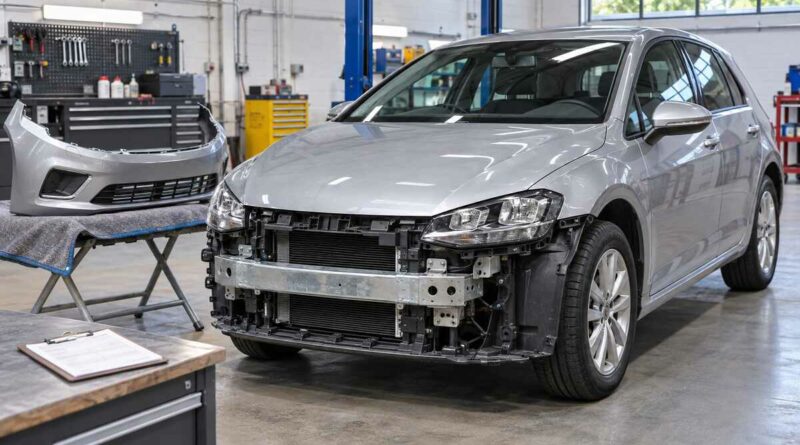
Insurance Write-Off Check: Categories, Records and Repair Risks
Estimated reading time: 8 minutes
An insurance write-off check searches available records for a vehicle’s reported total-loss history. It can identify a recorded category and raise important questions about damage and repairs. It cannot confirm repair quality or prove that a car with no record has never been damaged. Match the vehicle’s identity, examine the evidence and assess current condition before paying.
CarExamer generally does not recommend buying insurance write-off vehicles. The category and a tidy appearance leave too much unanswered without a clear damage and repair history. This guide explains how to use the check, what different results mean and which concerns need further assessment rather than a quick discount.
What an insurance write-off actually means
The insurer decides whether to treat the vehicle as a total loss. The Association of British Insurers’ salvage-code explanation describes financial and safety considerations. A total loss is not simply a measure of how dramatic the visible damage looks.
The category describes the recorded salvage decision, rather than certifying repairs performed later. I would separate the original incident, the categorisation, the repair process and the car’s present condition. Evidence for one stage does not automatically establish the others.
UK write-off categories at a glance
GOV.UK’s category guidance distinguishes vehicles that must not return to the road from repairable categories. Use the recorded category accurately instead of treating every write-off as the same proposition.
| Category | What it means for a buyer |
|---|---|
| A | Cannot be repaired; the entire vehicle must be crushed. |
| B | Cannot return as a repaired vehicle; the body shell must be crushed, although other parts can be salvaged. |
| S | Repairable following structural damage; it may be used again only when repaired to a roadworthy condition. |
| N | Repairable following non-structural damage; it may be used again only when repaired to a roadworthy condition. |
Category N does not mean that every affected item was cosmetic or unimportant to safety. The distinction is structural categorisation. Do not accept “only a bumper” without damage evidence, and do not use the category as a substitute for checking the systems actually affected.
The ABI’s May 2025 salvage code includes guidance for high-voltage electric vehicles and modern construction methods. An electric or hybrid vehicle may require specialist assessment of concerns beyond the visible body panels. Do not open or disturb high-voltage components during a viewing.
Run the check on the car you are actually viewing
Obtain the registration and compare it with the V5C, the seller’s information and the vehicle. Check the VIN as well, particularly where registration changes, imports or inconsistent records need clarification. A report for the wrong identity gives no reassurance about the car in front of you.
CarExamer’s free vehicle-data check helps compare basic details. For recorded risks, use a vehicle history check and read its coverage, date and terms. Do not assume that a free basic-data result includes a complete write-off or finance search.
The Motor Insurers’ Bureau now describes its relevant central claims records as Vehicle Salvage and Theft Data, held in Navigate. Older material may use MIAFTR. Public buyers normally use a provenance-check provider rather than access that professional database directly. Check what the selected report actually includes.
Interpret a clear result carefully
A clear result means the provider found no relevant record within the search and coverage stated. It does not prove that the vehicle has never had a collision, private repair, unreported damage or an event outside the data available. Avoid translating “no record found” into “accident-free”.
Compare the result with the advert, repair invoices and visible condition. If panel finishes, fasteners or accessible structures suggest earlier work, ask for an explanation even when the data check is clear. Record an unanswered question rather than allowing the report’s headline to override what you can see. Use these checks for signs of accident repairs to guide the viewing.
A history report and an inspection therefore complement each other. One concerns available records; the other concerns findings within the access and tests completed. Neither should be represented as an unlimited guarantee.
For example, a clear report paired with unexplained body repairs needs further questions. A recorded Category N car with no original photographs still has an evidence gap. A detailed repair folder may help an assessor, but it does not remove the need to examine current condition. Keep each conclusion tied to the evidence actually available.
What to request when a write-off is recorded
- The recorded category, date and identifiers from the report.
- Photographs showing the original damage, where available.
- The repairer’s identity and itemised invoices.
- Evidence explaining replacement parts and relevant repair procedures.
- Diagnostic, alignment or calibration records where relevant to the affected systems.
- Any later assessment, with its scope and limitations.
A salvage photograph can help explain an incident, but one image cannot show every damaged area or subsequent repair. Ask which parts of the vehicle were examined and what remains concealed. If the photographs do not match the actual car or account, stop and investigate the discrepancy.
I would compare the described damage with the repair evidence and accessible findings. A quotation is not proof of completed work. An alignment printout does not establish every structural dimension, and a cleared fault code does not prove that an airbag or assistance system was repaired correctly.
Ask the assessor to state which areas were accessible, which tests were completed and what could not be established. Photographs should identify the relevant finding rather than merely show that the car was present. If a conclusion depends on further testing, leave it conditional until that work is done. This helps avoid a broad “checked” label hiding an unresolved concern.
Our Category N buying guide examines repair risks in more detail. This broader write-off check should be the beginning of the evidence review, not the final approval to buy.
An MOT or log book is not a repair certificate
The government’s repaired-write-off buying guide recommends checking history, repairs, identity and condition. A current MOT is useful, but it does not provide a complete investigation of hidden repair work or certify the original repair process.
Do not rely on an unmarked V5C as proof of a clear history. GOV.UK distinguishes the recording arrangements for Category S from Category N. Our V5C check guide explains why the registration certificate has limits and is not proof of ownership.
If further structural measurements, dismantling or specialist electronic testing are required, establish those arrangements before purchase. A general viewing cannot answer every repair-quality question, especially where the relevant areas remain covered.
Check insurance, price and the exit risk before buying
Contact the proposed insurer before committing and disclose the known write-off history accurately. The government’s consumer guide warns that not all insurers automatically cover these vehicles and that cost can differ. Obtain terms for the actual registration and circumstances rather than assuming a generic quote will apply.
There is no dependable universal discount that makes a write-off good value. Compare the asking price with relevant examples, allow for known work and consider how the history may affect a later sale. An unresolved safety or repair concern should not be converted into an arbitrary price reduction.
Keep a dated copy of the advert, seller’s account, report and repair documents. Write down what was disclosed before you agreed to buy, and obtain any promised clarification before payment. If the history changes between enquiry and collection, revisit the decision rather than treating the original price agreement as a reason to continue.
If a report appears inaccurate, the MIB’s data guidance says the organisation responsible for the entry must address amendments. Obtain clarification through the appropriate provider. CarExamer does not provide a service to appeal a write-off category, and a condition assessment does not erase a record.
For a vehicle inspection, confirm the appropriate assessment scope and required repair evidence before booking. Pause when important questions cannot be resolved. Buying an alternative vehicle can be the more practical decision than accepting uncertainty because the advert looks inexpensive.
Frequently asked questions
What is an insurance write-off check?
It searches available records for reported total-loss history. Read the provider’s coverage and match the report to the actual vehicle.
Can a car be safe after being written off?
Categories S and N can return to use when repaired to a roadworthy condition. The category alone does not confirm the quality of a particular repair.
Does a write-off show on the V5C?
Do not rely on the V5C alone. GOV.UK records Category S differently from Category N, so use a relevant history check alongside the document.
Can you insure a write-off car?
Ask the proposed insurer before buying. Acceptance, terms and price depend on the insurer and vehicle; a quotation for another car does not establish cover.
Is Category S worse than Category N?
S identifies structural damage; N identifies non-structural damage. They are not a simple ranking of every safety issue or the quality of later repairs.