Car Oil Leak Signs: Causes, Checks and When to Stop
Fresh oily marks, a falling oil level, wet engine components or a burning smell can indicate an oil leak. They do not identify its source on their own. I would establish which fluid is involved, how actively it is escaping and whether there are warning messages or other symptoms before discussing repair costs.
An oil-pressure warning while the engine is running needs a different response from an old stain or slight dampness. Stop as soon as it is safe, switch off the engine and follow the vehicle’s handbook. Do not continue a viewing or road test simply because the seller says the warning is only a sensor.
Oil level and oil pressure are different
Oil level is the amount available in the sump or measured system. Oil pressure concerns the engine’s lubrication supply while operating. A correct level does not prove that pressure is satisfactory, and topping up does not explain why a warning appeared.
Ford’s dashboard-warning guidance says to stop safely and switch off when the oil-pressure lamp illuminates with the engine running. If the level is sufficient, a system fault still needs immediate assessment. Identify the exact warning rather than confusing it with an oil-service reminder or a separate low-level message.
Check whether the fluid is actually engine oil
A mark under a car could involve engine oil, transmission fluid, coolant, fuel or another substance. Air-conditioning condensate may also leave water beneath a vehicle. Colour and position offer clues, but contamination and ageing make them unreliable as a complete identification method.
The RAC’s fluid-leak guide explains the broad differences. Do not taste fluids, handle unknown substances or deliberately inhale vapours. If fuel, brake fluid or another safety-related leak is suspected, stop using the vehicle until the concern has been assessed.
Note where the car was parked and whether the mark is fresh. A stain already on a dealer’s forecourt may belong to another vehicle. Conversely, an undertray can retain fluid, so the absence of a puddle does not establish that the engine is dry.
Distinguish a stain, seep and active leak
A dry residue may relate to an earlier repair or a spill. Dampness suggests fluid is present, but the rate and source may remain unclear. Fresh runs, forming drops or repeated marks provide stronger evidence of active leakage. Describe what is visible rather than using “just sweating” as a substitute for assessment.
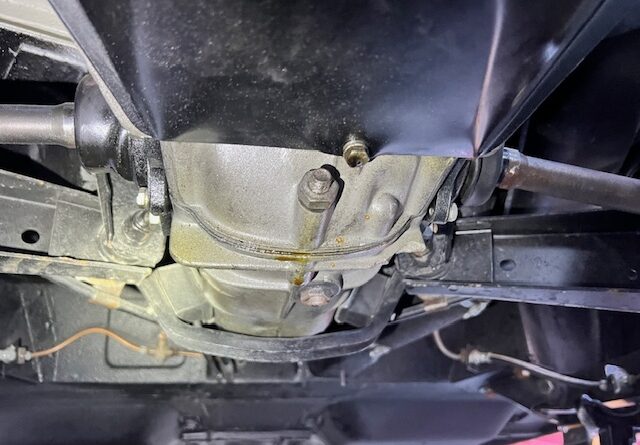
I would ask whether the area has changed, whether the level needs topping up and whether the leak was previously investigated. Even a small observation can matter if it contaminates another component or cannot be accessed properly. Equally, a photograph of an oily casing alone does not justify declaring the whole engine unserviceable.
Why the drip location may mislead you
Oil can travel down the engine, along a casing or across an undertray before reaching the ground. Airflow during driving can spread it further. The lowest wet point is therefore not necessarily the component that failed. A leak apparently near the gearbox may require investigation above it as well as around the joint.
Access and cleanliness affect diagnosis. A workshop may need controlled cleaning and a follow-up examination to trace the source. If the engine has just been washed, ask what prompted it and whether there is repair evidence. A clean bay is not proof of a repair, and it is not proof of concealment either.
Possible sources need confirmation
Depending on the engine, potential sources include a cam-cover gasket, oil-filter housing, sump joint, drain plug or shaft seal. The design and recent work matter. A loose description such as “a gasket” does not explain which part is involved, how accessible it is or whether another fault contributed.
Ask the repairer to identify the source and the evidence supporting it. An oil leak following a service should prompt checks of the work completed, but timing alone does not prove the service caused it. Retain the invoice and any photographs before the area is cleaned or repaired.
Our oil and filter change guide provides context for routine servicing. A scheduled oil change and a leak repair are separate jobs. Fresh oil in the engine does not resolve a leaking housing or confirm that the correct level has been maintained.
A falling level can also mean oil consumption
Frequent topping up does not prove an external leak. Oil may be consumed internally, and there may be more than one issue. Blue exhaust smoke can be associated with oil burning, but its cause needs diagnosis rather than an immediate assumption about piston rings, a turbocharger or a particular seal.
The RAC’s engine-smoke guidance describes several possible sources. Record whether smoke occurs at startup, after idling or during acceleration, if this can be observed safely. Smoke under the bonnet is a different observation from smoke emerging from the tailpipe.
Ask how much oil has been added over what mileage and how the measurements were taken. Compare the figures with manufacturer guidance for the exact engine and investigate changes. “They all use oil” is not evidence that this car’s behaviour is acceptable.
Check the level using the correct procedure
Follow the handbook for the required surface, engine condition and waiting period. Some cars use a dipstick and others an electronic measurement. Do not apply one generic hot-or-cold rule to every system. If conditions do not permit a valid reading at the viewing, record that limitation.
Use only the specified oil when topping up, and do not overfill. Ford’s oil-maintenance advice highlights the correct specification, regular checks and investigation of frequent top-ups. Oil grade alone does not necessarily establish the required manufacturer approval.
An apparently correct reading immediately after topping up does not show the rate of loss. Request previous records and repair evidence. Our service-history guide explains why documented work is more useful than a general assurance that maintenance has been done.
Burning smells and fresh leakage need prompt attention
An oily smell may accompany fluid contacting hot components, but it is not a reliable way to identify the precise leak. Look for associated smoke or warning messages from a safe position. Do not reach near a running engine, touch hot exhaust components or open a hot pressurised cooling system.
If there is smoke, a serious leak, abnormal engine noise or a warning, stop the test and arrange appropriate help. Do not drive a car with an unresolved oil-pressure warning to see whether it clears. Mobil’s oil guidance explains that several faults can produce a warning and that continued operation with low pressure can cause serious damage.
What does an MOT oil-leak advisory tell you?
Read the exact wording and compare successive tests. An observation from a previous MOT is a reason to ask what happened next, not a quotation for a particular repair. The DVSA inspection manual sets the relevant fluid-leak test criteria; a pass is not a general guarantee against developing leaks.
A later test without the note does not establish how a repair was completed. Ask for invoices and assess present condition. Our MOT advisories guide explains how to interpret repeated or disappearing observations without overstating what the record proves.
Get a diagnosis before negotiating a repair allowance
Labour access can make two apparently similar leaks very different jobs. Ask for a current written quotation identifying the source, proposed work, associated seals or fluids, labour and VAT. Clarify whether dismantling is needed to confirm the final scope. An internet price for a gasket is not the cost of completing the repair.
For example, a seller may offer a discount and describe a leak as inexpensive, while no workshop has identified its source. The sensible next step is a diagnosis, not treating that reduction as a repair budget. Our oil-service cost guide concerns routine maintenance; it should not be used as a leak-repair quotation.
What evidence should follow a repair?
Request an invoice describing the source found and the work completed, not simply “oil leak fixed”. Ask whether the area was rechecked and whether any further monitoring is needed. Where access required removing covers, photographs can help explain the findings. A clean casing immediately after the work is less informative than a documented follow-up assessment under appropriate conditions.
If the seller promises a repair before collection, agree the exact scope and supporting evidence in writing. Check the completed work before paying the balance where possible. Do not assume that a new gasket resolves a separate consumption issue or an earlier oil-pressure warning.
A practical checklist before buying
- Record the exact warning, symptom and conditions.
- Check the oil level only using the correct procedure.
- Ask about top-ups, prior diagnosis and completed repairs.
- Compare MOT and service records with present condition.
- Arrange safe underside access where appropriate.
- Obtain further diagnosis if the source or severity remains uncertain.
- Do not proceed on a seller’s unsupported repair estimate.
Compare CarExamer’s Standard inspection and other pre-purchase inspection options. Arrange a vehicle inspection with your concerns supplied in advance. Accessible leakage can be documented, but covers, cleaning and intermittent symptoms may limit conclusions. A pre-purchase assessment does not dismantle the engine or guarantee that no future leak will occur.