6 Types of Tyre Wear and What They All Mean
Estimated reading time: 7 minutes
Tyres are the only part of your vehicle that touch the road. Every kilogram of weight, every acceleration, every braking force and every cornering movement is transferred through four relatively small contact area. Because of this, tyre wear is inevitable. However, not all tyre wear is normal. Understanding tyre wear patterns is one of the simplest and most effective ways to diagnose mechanical issues early. Uneven tyre wear can point to alignment faults, suspension damage, incorrect tyre pressure or balancing problems. Ignoring these signs can lead to reduced grip, longer stopping distances, MOT failures and expensive repairs. In this guide, we will break down the six most common types of tyre wear, what causes them, how to fix them, and what they mean for vehicle safety.
Why Tyre Wear Patterns Matter
Tyres naturally wear down over time. The legal minimum tread depth in the UK is 1.6mm across the central three quarters of the tyre. However, waiting until tyres reach the legal minimum is not recommended.
For safety reasons, many professionals advise replacing tyres once they reach around 3mm. When buying a used car, 5mm of tread depth is generally considered healthy, representing roughly half of the tyre’s usable life.
Uneven tyre wear is more concerning than general wear. It suggests the tyre is not making correct contact with the road surface, which can compromise grip, stability and braking performance.
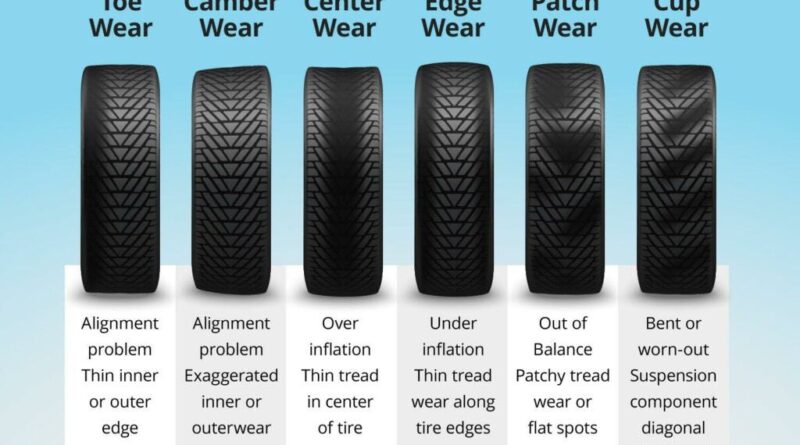
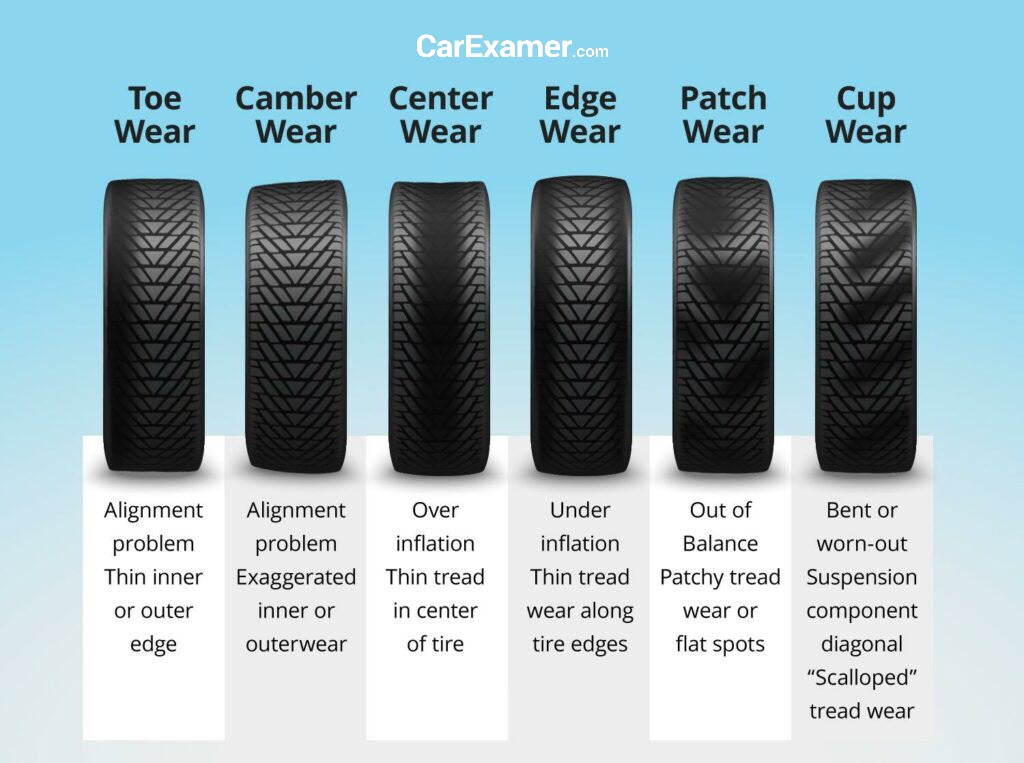
Let’s examine the six most common types of tyre wear.
1. Toe Wear (Feathering)
Toe wear, often called feathering, occurs when the inner or outer edge of the tyre tread ribs wear down unevenly. If you run your hand across the tread, it may feel smooth in one direction and sharp in the other.
What Causes Toe Wear?
Toe wear is usually caused by incorrect wheel alignment. Specifically, the toe angle may be set incorrectly, meaning the wheels point slightly inward or outward rather than straight ahead.
Even a small alignment error can cause rapid tyre wear over thousands of miles.
Risks of Toe Wear
• Reduced tyre life
• Poor fuel economy
• Steering instability
• Uneven braking performance
How to Fix It
A professional four-wheel alignment is required. Adjusting the toe angle ensures even road contact and prevents further abnormal wear.
2. Camber Wear
Camber wear occurs when one side of the tyre tread wears more heavily than the other. This is usually seen as heavy wear on the inside or outside edge.
What Causes Camber Wear?
Camber refers to the inward or outward tilt of the wheel when viewed from the front. Excessive negative camber (tilted inward) or positive camber (tilted outward) causes uneven load distribution across the tread.
Camber wear may result from:
• Suspension damage
• Lowered or modified suspension
• Worn suspension components
• Incorrect alignment
Risks of Camber Wear
• Reduced cornering grip
• Increased aquaplaning risk
• MOT failure
• Poor handling
How to Fix It
Wheel alignment should be checked and suspension components inspected for damage or wear.
3. Centre Wear
Centre wear is when the middle section of the tyre tread wears down faster than the outer edges.
What Causes Centre Wear?
This is almost always caused by over-inflation. When tyre pressure is too high, the centre of the tyre bulges outward, making greater contact with the road.
Risks of Centre Wear
• Reduced braking performance
• Smaller contact patch
• Increased stopping distance
• Reduced grip in wet conditions
How to Fix It
Check tyre pressures regularly and adjust them to the manufacturer’s recommended levels, typically found on the door pillar or fuel cap area.
4. Edge Wear (Shoulder Wear)
Edge wear is the opposite of centre wear. The outer shoulders of the tyre wear down faster than the centre.
What Causes Edge Wear?
Under-inflation is the most common cause. Low tyre pressure increases contact at the edges while the centre lifts slightly.
Risks of Edge Wear
• Increased rolling resistance
• Poor fuel economy
• Higher blowout risk
• Reduced handling stability
How to Fix It
Maintain correct tyre pressure and check it at least once a month.
5. Patch Wear (Out-of-Balance Wear)
Patch wear appears as random, uneven worn sections around the tyre circumference.
What Causes Patch Wear?
This type of wear is typically caused by wheel imbalance. When a wheel is not correctly balanced, it can bounce slightly as it rotates, creating uneven road contact.
Risks of Patch Wear
• Steering vibration
• Increased suspension wear
• Shortened tyre life
How to Fix It
Wheel balancing corrects weight distribution and restores smooth rotation.
6. Cup Wear (Scalloping)
Cup wear, also known as scalloping, appears as a wave-like or scalloped pattern around the tyre tread.
What Causes Cup Wear?
Cup wear is usually linked to worn or damaged suspension components such as:
• Shock absorbers
• Struts
• Suspension bushes
• Wheel bearings
When suspension components fail, tyres lose consistent road contact and bounce slightly, creating scalloped wear patterns.
Risks of Cup Wear
• Significant handling instability
• Noise while driving
• Dangerous braking behaviour
• Rapid tyre deterioration
How to Fix It
Suspension components must be inspected and replaced if necessary. Simply replacing tyres will not fix the underlying issue.
Run-Flat Tyre Codes Explained
Run-flat tyres are designed to continue operating after a puncture. Manufacturers use different codes to indicate run-flat technology.
Common run-flat codes include:
| Run-flat tyre codes | Make |
| AOE | Audi Original Extended |
| CS | Continental ContiSeal |
| CSR | Continental Conti Safety Rim |
| DSST | Dunlop Self Supporting Technology |
| EMT | Goodyear Extended Mobility |
| EUFORI@ | Pirelli |
| HRS | Hankook Runflat System |
| MOE | Mercedes-Benz Original Extended |
| PAX | Michelin |
| RFT | Run Flat Tyre |
| ROF | Run On Flat |
| RSC | Runflat System Component |
| SSR | Self Supporting Runflat |
| TRF | Toyo Run Flat |
| XRP | Kumho Extended Runflat Performance |
| ZP | Michelin Zero Pressure |
When buying a used car, confirm matching tyre types across the axle. Mixing run-flat and standard tyres is not recommended.
How Tyre Wear Affects MOT Results
Tyres are one of the most common MOT failure points. Issues that result in failure include:
• Tread below 1.6mm
• Uneven tyre wear exposing cords
• Cuts or bulges
• Incorrect tyre size
• Severe sidewall damage
Uneven tyre wear caused by suspension or alignment faults may also trigger advisory notes.
Tyre Wear and Used Car Buying
When purchasing a used vehicle, tyre condition tells a story about how the car has been maintained.
Healthy tyres should:
• Have even wear across the tread
• Measure at least 5mm ideally
• Match across each axle
• Show no cracking or perishing
Uneven tyre wear may indicate:
• Accident damage
• Poor maintenance
• Suspension faults
• Neglected alignment
A professional pre-purchase inspection can identify these issues before you commit to purchase.
How to Prevent Abnormal Tyre Wear
• Check tyre pressure monthly
• Rotate tyres every 6,000 to 8,000 miles
• Perform wheel alignment annually
• Balance wheels when fitting new tyres
• Inspect suspension annually
• Avoid aggressive driving
Small preventative actions significantly extend tyre life and improve safety. Ultimately, tyres are fickle and there is lots of room for issues when it comes to anything facing wear and tear. We have a whole guide on more general wear and tear for other areas here, but don’t forget that all of this is tested using an inspection service like ours. When buying a used car get vehicle inspection to inspect tyres we advise 5mm to be left as its 50% of tyre life left or in simple words 2 years of driving with average mileage 10000 miles a year.
FAQs
What are the most common types of tyre wear?
The most common types of tyre wear include toe wear, camber wear, centre wear, edge wear, patch wear and cup wear. Each pattern indicates a different mechanical or inflation issue.
What causes uneven tyre wear?
Uneven tyre wear is usually caused by incorrect wheel alignment, suspension faults, wheel imbalance or incorrect tyre pressure.
How much tread depth should a used car tyre have?
While the legal minimum is 1.6mm, a healthy used car tyre should ideally have 5mm of tread remaining for safety and longevity.
Can suspension problems cause tyre wear?
Yes. Worn shock absorbers, bushes or suspension components can cause scalloping or cup wear, leading to unsafe driving conditions.
Is centre tyre wear dangerous?
Yes. Centre tyre wear reduces the contact patch and can increase braking distance, particularly in wet conditions.