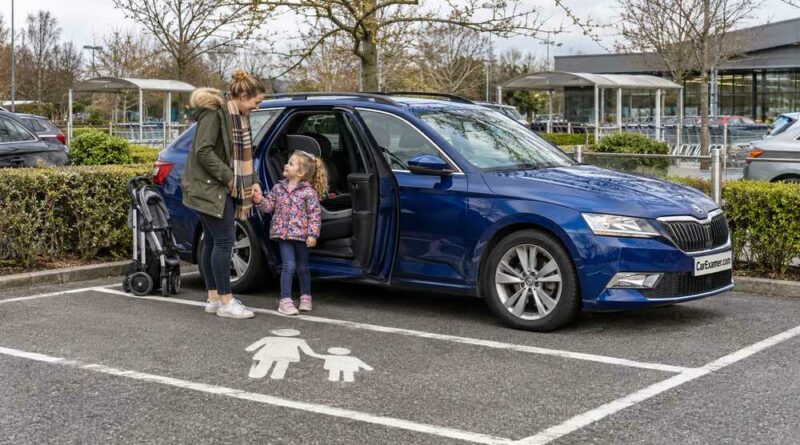
Parent and Child Parking Rules: Who Can Use the Bays?
Estimated reading time: 8 minutes
Parent-and-child parking rules depend on the car park’s signs and operator. Do not assume that every supermarket uses the same child age limit, permits the same circumstances or applies the same charge. The practical purpose of these bays is to provide room for families to get children into and out of vehicles, but the displayed conditions determine how the site expects them to be used.
Before leaving the car, check both the bay restrictions and the wider parking terms. A suitable child passenger does not automatically remove a maximum stay, payment requirement or registration-validation step. Understanding those separate requirements is the simplest way to avoid an unnecessary dispute.
Are parent-and-child bays required by law?
A government answer published in September 2026 states that parent-and-child bays are not prescribed or required by national legislation and that their provision in private car parks is a matter for the operator. That is different from saying private parking conditions can never be enforced.
A private operator may issue a Parking Charge Notice where it alleges that the displayed terms have been breached. This is not the same as a council Penalty Charge Notice, even though both may be abbreviated to PCN. Identify who issued a notice before deciding which procedure applies.
The Highway Code’s waiting and parking rules remain useful for general parking behaviour and safe door opening. They do not provide a universal supermarket parent-and-child age limit. Read the actual site signs rather than treating a general road rule as permission to use a particular marked bay.
Who can use a parent-and-child space?
Look for the eligibility wording at the bay and car-park entrance. It may refer to an accompanying child, an age limit or how the family is using the premises. Being a parent does not, by itself, establish eligibility when you are travelling alone.
Do not assume that an empty child seat is sufficient. It shows that the car can carry a child, not that a qualifying child is present on that visit. Equally, a family may be travelling with a grandparent, guardian or another carer. Read the wording rather than making assumptions about the adult’s relationship to the child.
If the signs are unclear, ask the store or operator before leaving the vehicle. Explain the actual circumstances and ask where you should park. A useful question is whether the bay can be used on this visit, rather than asking whether the store ‘usually allows families’. Keep any written clarification if it matters to your decision.
Is the age limit always under 12?
No single age limit should be assumed for every site. Check the wording in the car park you are using, including whether an age is stated as ‘under’ a particular number. Advice about another branch or a social-media comment may not reflect the current conditions.
Do not confuse parking eligibility with child-restraint law. The GOV.UK child-seat rules normally require a child car seat until age 12 or a height of 135 cm, whichever comes first. Those requirements concern travelling safely in the vehicle; they do not grant a right to use a parent-and-child parking bay.
A child may still need practical assistance even when a particular bay’s stated age condition no longer applies. Ask staff about suitable parking or assistance instead of assuming the sign has an exception. The aim is to find an appropriate arrangement without relying on an interpretation that the operator has not confirmed.
What about pregnancy or additional access needs?
Do not assume that pregnancy automatically qualifies, or that every operator excludes it. Ask the relevant store or car-park operator about its policy. If access is difficult, explain the practical problem and request a suitable option before parking where the conditions appear not to permit it.
Parent-and-child bays and accessible bays are different facilities. Having a child with you does not authorise use of an accessible bay reserved under its own conditions. Conversely, do not judge another person’s access needs from a brief glance or assume every disability is visible.
The Blue Badge guidance for England explains that off-street car parks have separate rules and that free parking should not be assumed. Check the applicable local guidance elsewhere in the UK. If your family needs an adjustment or extra assistance, contact the operator rather than treating the two types of bay as interchangeable.
Check the whole car park’s conditions
Eligibility for a family bay is only one part of the parking arrangement. Read the entrance and payment signs as well as the symbol painted on the ground. Before leaving the vehicle, establish:
- Whether the bay has an age or accompanying-child condition.
- The maximum permitted stay and any return restriction.
- Whether payment, a ticket or registration entry is required.
- Whether the facility is restricted to customers using particular premises.
- Who operates the car park and how to ask for clarification.
- What charge and appeal information the signs provide.
Tesco’s parking information explains that maximum stays depend on the store and directs drivers to the signs. Sainsbury’s parking guidance also tells customers to check displayed extensions and restrictions. These are reasons to verify the individual site, not evidence of a universal family-bay rule.
Use the extra space carefully
Park within the marked vehicle area and keep the access space available for its intended use. Check around the car before opening doors. A wider bay helps, but it does not eliminate moving vehicles, pedestrians or the possibility of another door entering the same space.
Think about the order in which you unload the child, pushchair and shopping. Keep children supervised and use a safe pedestrian route where provided. Do not leave a pushchair in a traffic lane while organising the boot, and avoid allowing doors to swing into adjacent vehicles.
Before leaving, check that everyone is properly seated and restrained and that doors and the boot are secure. Take time to check around the vehicle before manoeuvring. Cameras and sensors can assist, but they do not remove the need to look carefully for children and other pedestrians close to the car.
What if every parent-and-child bay is occupied?
Use a permitted alternative with enough room to manage safely, even if it means walking farther. Consider the pedestrian route as well as the distance from the entrance. An end space may help in some layouts, but it is not permission to park over markings or obstruct a walkway.
If no suitable space is available, ask staff for assistance or wait somewhere parking is allowed. Do not block another vehicle, use an accessible bay without meeting its conditions or stop in a traffic route simply because the family spaces are full.
If you think a bay is being misused, report the concern to staff without confrontation. You may not have seen who arrived in the vehicle or know the occupants’ circumstances. Staff can explain the site’s policy and decide what action is appropriate. Avoid photographing or publicly identifying children or families as part of an argument.
What should you do if you receive a charge?
Read the notice carefully and check the issuer, vehicle details, alleged breach, dates, amount and response deadline. Do not assume an article quoting £70 describes your notice, and do not ignore it because the car park was privately operated.
Preserve relevant evidence: photographs of the signs and bay, receipts, parking-payment records and any written permission. Explain the actual circumstances clearly if you challenge the charge. Share only information needed to support the case, rather than sending unnecessary personal details about a child.
GOV.UK’s ticket-challenge guidance says to contact the private issuer first. If rejected, the appropriate independent appeal route depends on the operator’s accredited trade association, with POPLA for BPA members and IAS for IPC members. Follow the notice and current instructions; do not transfer a council-ticket deadline to a private notice. Obtain appropriate advice if liability or court correspondence is disputed.
Make sure the car works for your family
Parking access is also a useful consideration when choosing a used car. Try opening the rear doors in a realistic space and check whether you can reach the child-seat positions comfortably. Test the boot with the pushchair and equipment you normally carry, rather than relying only on a published luggage-capacity figure.
Our questions to ask when buying a used car help you assess suitability alongside history and running costs. Follow the vehicle and child-seat manufacturers’ fitting instructions when checking compatibility. A roomy-looking rear bench does not establish that every restraint arrangement is suitable.
A vehicle inspection can help assess accessible condition before purchase. Read about pre-purchase inspections and confirm the agreed scope, while making your own practical family-access checks. Choosing a suitable car helps with everyday use, but the parking rules still depend on the signs at each destination.